Article · 6 July 2026
ADA Assay Design for Denosumab Biosimilars: The sRANKL Interference Problem and How to Solve It
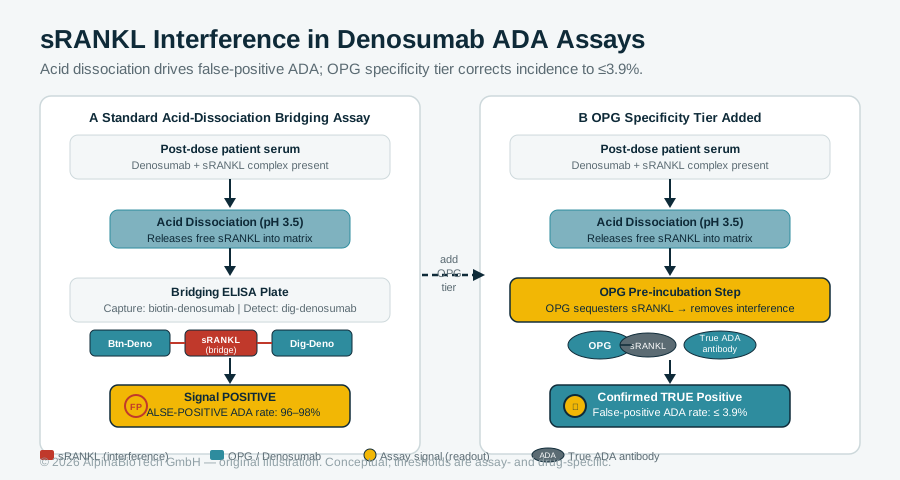
Standard acid dissociation pretreatment in denosumab anti-drug antibody bridging assays can generate false-positive ADA rates approaching 96 to 98%, driven by soluble RANKL accumulation after dosing. Adding osteoprotegerin as a specificity tier corrects observed false-positive incidence to 3.9% or below. This article reviews the assay mitigation strategy alongside the clinical immunogenicity evidence from ten FDA-approved denosumab biosimilar programs.
AlpinaBioTech
Research Use Only. For investigational and research purposes.
The denosumab biosimilar landscape has expanded faster than any other US biosimilar class in the past two years. As of March 2026, ten pairs of biosimilars referencing Prolia and Xgeva had received FDA approval, completing a regulatory wave that compressed eight separate approval events into roughly twelve months. For the immunogenicity assay scientist, this expansion creates an immediate practical problem: the standard ADA bridging workflow that functions adequately for most monoclonal antibodies is not fit for purpose here. Soluble RANKL (sRANKL), the pharmacological target of denosumab, accumulates post-dose and floods a standard bridging assay with a false-positive signal that can approach 100% if acid dissociation is applied without a mitigation step.
The tension between a mature and growing clinical evidence base and this underappreciated analytical artifact is the problem worth examining now.
The Clinical Evidence Base in 2026
Denosumab is a fully human IgG2 monoclonal antibody targeting RANKL, a key driver of osteoclast-mediated bone resorption. The first FDA approvals for denosumab biosimilars came in March 2024, with Sandoz receiving approval for both Jubbonti (referencing Prolia) and Wyost (referencing Xgeva), both interchangeable with the reference products for all indications [14].
The complete sequence of ten pairs approved through mid-2026 is as follows:
- Pair 1: Jubbonti and Wyost (denosumab-bbdz, Sandoz), March 5, 2024 [14]
- Pair 2: Ospomyv and Xbryk (denosumab-dssb, Samsung Bioepis), February 13, 2025 [15]
- Pair 3: Stoboclo and Osenvelt (denosumab-bmwo, Celltrion), approved February 28, 2025, making Celltrion the third company to receive FDA approval for a denosumab biosimilar [19]
- Pair 4: Conexxence and Bomyntra (denosumab-bnht, Fresenius Kabi), approved March 2025 [3]
- Pair 5: Bildyos and Bilprevda (denosumab-nxxp, Shanghai Henlius Biotech and Organon), approved August 2025 [5]
- Pair 6: Bosaya and Aukelso (denosumab-kyqq, Biocon Biologics), approved September 16, 2025 [7]
- Pair 7: Enoby and Xtrenbo (denosumab-qbde, Hikma Pharmaceuticals and Gedeon Richter), approved September 26, 2025 [7]
- Pair 8: Osvyrti and Jubereq (denosumab-desu, Accord BioPharma), approved October 29, 2025, marking the eighth set of denosumab biosimilars approved by the FDA [16]
- Pair 9: Boncresa and Oziltus (denosumab-mobz, Amneal Pharmaceuticals and mAbxience), the ninth pair overall to receive FDA approval [2]
- Pair 10: Ponlimsi (denosumab-adet, Teva), approved March 27, 2026, for all indications of Prolia [12]
In the EU, the EMA's CHMP adopted a positive opinion for Denosumab Ascend on June 25, 2026, for prevention of bone complications in adults with advanced cancer involving bone and for treatment of giant cell tumour of bone [17], indicating the European pipeline remains active beyond US approvals.
Efficacy Data Supporting Biosimilarity
The data supporting these approvals now cover both Western and Chinese postmenopausal populations. A systematic search of PubMed/Medline, Ovid-Embase, and Web of Science to April 2025 identified randomized controlled trials comparing denosumab biosimilars with either the originator or placebo, with data on BMD, bone turnover markers, adverse events, and immunogenicity synthesized descriptively. Eleven RCTs met the inclusion criteria [1].
The GP2411 program (ROSALIA study, NCT03974100) provides the most fully documented Western active-controlled equivalence dataset. ROSALIA was a multicenter, double-blind, randomized, integrated phase I/phase III study comparing the efficacy, PK, PD, immunogenicity, and safety of proposed biosimilar denosumab GP2411 with reference denosumab (Prolia, Amgen) [11]. The adjusted mean change in lumbar spine BMD at week 52 was 4.89% (95% CI: 3.55 to 6.24) for GP2411 and 4.55% (95% CI: 3.22 to 5.87) for reference denosumab, with an estimated difference of 0.34 percentage points (95% CI, -0.40 to 1.09) [20]. The 95% CI of the mean difference fell within the pre-defined equivalence margin of -1.45 to 1.45%, demonstrating that GP2411 was equivalent to reference denosumab. Anti-drug antibody incidence was less than 1% in both arms [20].
Chinese Phase 3 programs extend this picture. The QL1206 candidate was evaluated in 455 postmenopausal women with osteoporosis across 31 study centers, randomized to receive QL1206 (60 mg subcutaneously every 6 months) or placebo. From baseline to 12-month follow-up, QL1206 recipients showed significantly increased BMD at the lumbar spine (4.780%, 95% CI: 3.880 to 5.681%), total hip (3.930%, 95% CI: 3.136 to 4.725%), and femoral neck (2.733%, 95% CI: 1.877 to 3.589%) [5].
The MW031 program, evaluated in 448 randomized Chinese postmenopausal women, showed 5.80% BMD increase at the lumbar spine, 3.65% at the total hip, and 2.93% at the femoral neck after 12 months, with serum CTX suppression reaching a maximum difference of -71.71% (95% CI: -77.83% to -65.60%, P less than 0.0001) at month 1 compared with placebo [4].
The Assay Problem: sRANKL Interference
The immunogenicity read-outs in these trials look reassuringly clean at the summary level. Getting to a clean number, however, requires solving a specific interference problem that standard ADA bridging assays are not equipped to handle without modification.
The interference mechanism originates with the pharmacology of the drug itself. RANKL exists as a trimeric soluble protein (sRANKL) with high affinity for denosumab; post-dose, sRANKL levels can rise due to drug-target complex accumulation, creating a risk of interference in bridging ADA assays, particularly after acid dissociation [8, 9].
This is not a theoretical risk. Acid dissociation significantly exacerbated target interference, resulting in ADA positivity rates of approximately 96 to 98% in clinical studies [8, 9]. The Fresenius Kabi paper, published in Bioanalysis (Tandfonline DOI: 10.1080/17576180.2025.2607080) and also available as PMC12928644, PMID 41457708, documents the mechanism and the mitigation in detail. Note that sources [8] and [9] are the same study: the Tandfonline URL is the journal version and the PMC record is the open-access deposit of the same FKS518 immunogenicity investigation [8, 9].
The investigation confirmed that sRANKL interfered with ADA detection in both screening and confirmatory tiers, leading to false-positive signals and overreporting of ADA incidence in both arms and in both studies evaluated [8, 9].
In plain terms: if a laboratory applies acid dissociation to improve drug tolerance in a denosumab ADA bridging assay without first evaluating sRANKL interference, it can inadvertently generate false-positive ADA rates approaching 100%. For a sponsor trying to demonstrate biosimilarity, or for a clinical researcher interpreting a patient's immunogenicity result, that number is not just inflated, it is analytically meaningless.
The Multi-Tiered Mitigation Strategy
The Fresenius Kabi team resolved the problem by inserting a specificity tier. They evaluated sRANKL interference in the ADA bridging assay and, to competitively block sRANKL, introduced a specificity tier by adding osteoprotegerin (OPG). This approach enabled reanalysis of previously ADA-positive samples to confirm whether signals represented true ADA responses or artifacts caused by sRANKL interference [8, 9].
Introducing the specificity tier corrected ADA incidence to 3.9% or below. OPG incorporation did not change the minimum required dilution (MRD) of the assay and did not affect signals for negative or positive controls, confirming overall assay integrity [8, 9].
The validated multi-tiered immunogenicity workflow for denosumab programs therefore requires four elements working in sequence:
- Screening tier: serum samples analyzed against a validated cut-point
- Confirmatory tier: inhibition by excess drug to confirm specificity of binding
- Specificity tier: OPG added to competitively block sRANKL and distinguish target interference from true ADA signal
- Neutralizing antibody (NAb) tier: functional assay applied to confirmed ADA-positive samples
A multi-tiered strategy encompassing screening, confirmatory, and specificity tiers provided a robust solution applicable to programs facing similar challenges [8, 9].
Assay Platform Context: The Chinese Population Programs
The Chinese Phase 3 programs are analytically relevant beyond their geographic scope. They document assay platforms and immunogenicity rates against which Western laboratories can benchmark their own methods.
For CMAB807, ADA samples were analyzed using a bridging electrochemiluminescence immunoassay (bridging-ECLIA) on the MSD Discovery Workbench platform. The PK profiles of CMAB807 and denosumab were similar: geometric mean ratios of Cmax, AUC0-t, and AUC0-infinity were 102.41%, 104.15%, and 103.89%, respectively, with 90% confidence intervals within the 80.00 to 125.00% bioequivalence window [10].
Across the MW031 data, immunogenicity was low, with only 1.8% of MW031 recipients testing positive for ADA, and a single case (0.3%) testing positive for neutralizing antibodies [4]. These near-zero figures are only interpretable if the assay was designed to separate true ADA signals from sRANKL artifact. Published methodological detail at the assay level remains sparse in most trial reports, but the consistent low rates across programs suggest shared awareness of the interference risk.
PD Biomarkers as an Orthogonal Check
Because true neutralizing antibodies against denosumab would be expected to attenuate RANKL inhibition, serum CTX suppression and P1NP reduction provide a pharmacodynamic window into drug activity that ADA-positive patients with functional ADAs would exit.
Serum concentrations of study drugs and of bone turnover markers CTX and P1NP were similar between treatment groups throughout the ROSALIA study [20]. In the MW031 pharmacokinetic substudy, the pharmacodynamic parameter sCTX in the MW031 and reference denosumab groups were similar, and the positivity rates of immunogenicity were 0% in both groups [4].
Integrating PD marker data alongside tiered ADA testing is the fit-for-purpose approach for denosumab immunogenicity monitoring, particularly in biosimilar programs where low-titer or transient ADA responses may be borderline detectable. In the ROSALIA study, for more than 98% of participants with detected ADAs, signals were borderline detectable by the method and consequently reported as ADA titer-negative, demonstrating the low immunogenic capacity of both GP2411 and reference denosumab. The overall non-neutralizing and transient nature of the vast majority of observed ADAs in this study supports this conclusion [20].
Regulatory and Market Context
The FDA approval of Boncresa and Oziltus (denosumab-mobz) resulted from a collaboration between Amneal Pharmaceuticals and mAbxience, a group majority-owned by Fresenius Kabi, with mAbxience handling development and manufacturing while Amneal held exclusive US commercialization rights [2, 6].
The US denosumab biosimilar market now includes Sandoz's Jubbonti and Wyost (approved March 2024), Celltrion's Stoboclo and Osenvelt (approved February 28, 2025), and Fresenius Kabi's Conexxence and Bomyntra (approved March 2025) [3, 14, 19]. Stoboclo and Osenvelt later received an interchangeability designation in October 2025, as did Conexxence and Bomyntra; Bosaya and Aukelso simultaneously received interchangeability designations at the time of their approval [13].
As each additional program submits its data package, the sRANKL interference question will remain an active methodological concern for every laboratory building or qualifying ADA assays for this analyte class.
Key Takeaways for Assay Scientists
- Standard acid dissociation pretreatment in denosumab ADA bridging assays can drive false-positive rates to approximately 96 to 98%; the treatment should not be applied without prior sRANKL interference assessment [8, 9].
- Adding OPG to a specificity tier corrects observed ADA incidence to 3.9% or below, without altering assay MRD or control signals [8, 9].
- Sources [8] and [9] cited in this article are the same study: the Tandfonline DOI is the journal version and PMC12928644 (PMID 41457708) is the open-access deposit of the same Fresenius Kabi FKS518 immunogenicity investigation.
- PD markers, specifically serum CTX and P1NP, provide orthogonal confirmation of drug activity and complement tiered ADA data in biosimilar immunogenicity programs [4, 20].
- The systematic review literature now spans eleven RCTs identified by a search covering PubMed/Medline, Ovid-Embase, and Web of Science to April 2025, supporting consistent BMD gains across Western and Chinese postmenopausal populations [1].
- Ten denosumab biosimilar pairs had received FDA approval in the US as of March 27, 2026; immunogenicity assay methodologies developed for these programs should be fully documented and transferable across switching and long-term follow-up studies [12, 14].
All assay reagents and kits referenced in this article are for Research Use Only (RUO). Not for use in diagnostic procedures.
Sources
- [1] pubmed.ncbi.nlm.nih.gov
- [2] centerforbiosimilars.com
- [3] pearceip.law
- [4] centerforbiosimilars.com
- [5] nature.com
- [6] pharmacytimes.com
- [7] drugs.com
- [8] tandfonline.com
- [9] pmc.ncbi.nlm.nih.gov
- [10] frontiersin.org
- [11] clinicaltrials.gov
- [12] biologicshq.com
- [13] centerforbiosimilars.com
- [14] drugs.com
- [15] goodwinlaw.com
- [16] goodwinlaw.com
- [17] ema.europa.eu
- [18] pubmed.ncbi.nlm.nih.gov
- [19] goodwinlaw.com
- [20] pmc.ncbi.nlm.nih.gov
- [21] prnewswire.com
More articles
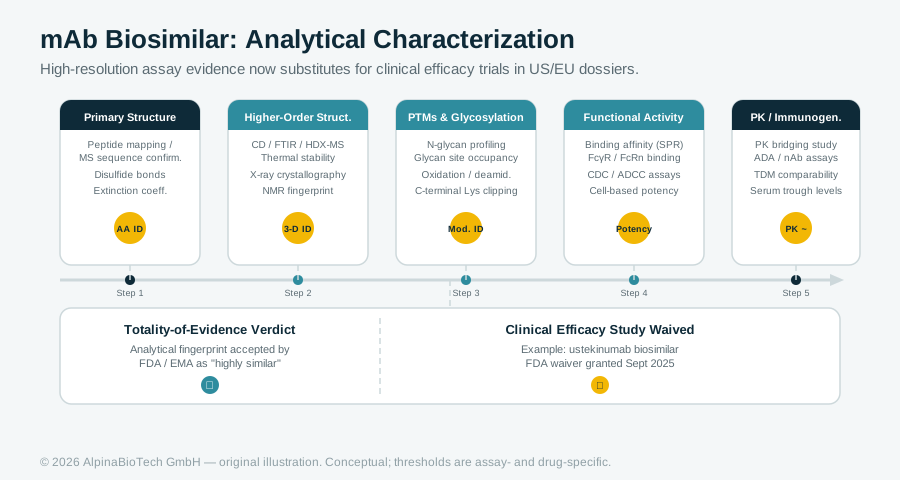
What "Highly Similar" Actually Requires: Analytical Methods for mAb Biosimilar Characterization
Regulatory approval of mAb biosimilars now depends less on replicating clinical trial results and more on high-resolution analytical characterization. A 2026 BioDrugs review of successful US and EU dossiers maps the assay strategies that matter, while the FDA's September 2025 waiver of a clinical efficacy study for a ustekinumab biosimilar makes the principle concrete for immunoassay and TDM scientists.
Read more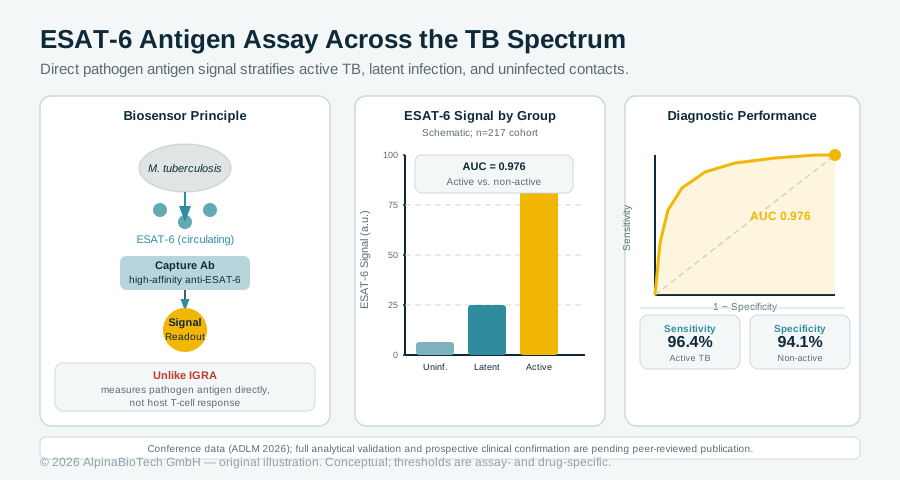
Measuring the Pathogen, Not the Host: A High-Sensitivity ESAT-6 Blood Assay Distinguishes Active TB Across the Infection Spectrum
A high-sensitivity biosensor for circulating ESAT-6 protein, a direct secretory product of Mycobacterium tuberculosis, produced a stepwise quantitative signal across the full TB infection spectrum in a 217-patient cohort presented at ADLM 2026. Unlike IGRAs, which measure host immune response, this antigen-direct approach distinguished active disease from latent infection and uninfected contacts with an AUC of 0.976, as reported in conference coverage pending peer-reviewed publication. Full analytical validation and prospective clinical data remain outstanding.
Read more